

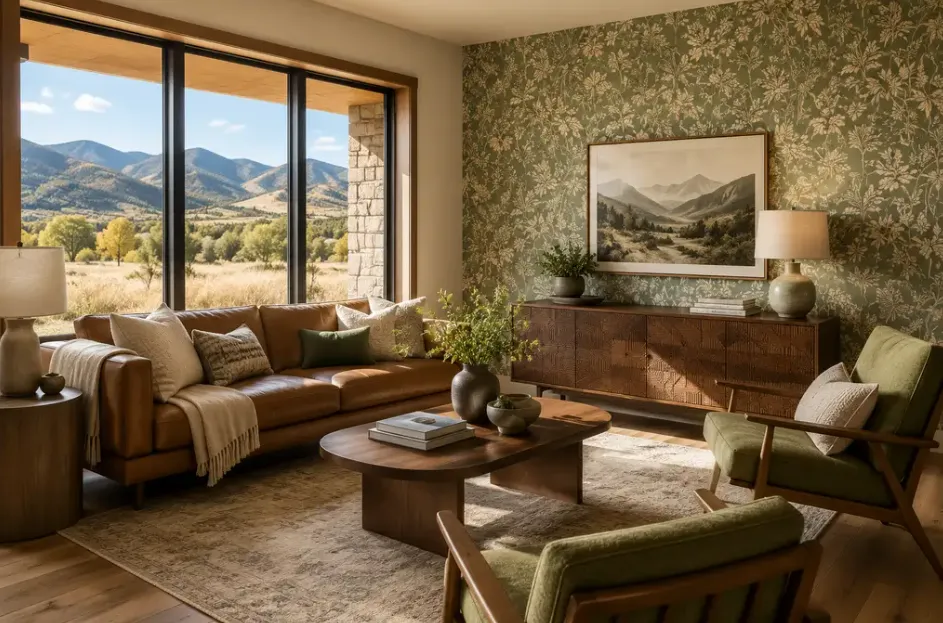
Boulder’s design sensibility has always leaned toward the organic — reclaimed wood, stone accents, big windows that frame the Flatirons. For years, paint dominated Front Range interiors here. It was fast, forgiving, and low-commitment. But homeowners across Boulder are increasingly finding that flat walls don’t tell much of a story. A single feature wall, a wrapped reading nook, or a fully wallpapered dining room can do more for a home’s character in one weekend than months of furniture shopping ever could.
The Boulder Effect: Nature-Inspired Interiors
It makes sense that when Boulder homeowners started reaching for wallpaper, they gravitated toward botanical prints, grasscloth textures, and earthy palettes that echo the landscape just outside their windows. This is exactly the aesthetic Boulder does best — a home that feels connected to the mountains rather than boxed away from them.
This is also where professional installation becomes non-negotiable rather than optional. Grasscloth and natural-fiber wallcoverings are unforgiving materials — they don’t hide seams the way vinyl does, and they react to humidity and adhesive differently than standard paper. A homeowner searching for wallpaper installation in Boulder, Colorado quickly learns that the material itself is only half the equation; the installer’s technique determines whether that grasscloth looks like a designer feature or a DIY mishap.
Why Installation Quality Matters More in Colorado
Colorado’s dry climate and dramatic seasonal humidity swings create real challenges for wallcovering longevity. Paper that’s improperly hung — with air bubbles trapped underneath or seams that weren’t properly rolled — tends to show its flaws within the first year here far more visibly than in more humid climates. Adhesive curing times, wall prep, and even the direction of pattern railroading all need to account for Colorado’s specific conditions, and Boulder’s elevation and dry air make this even more pronounced than in lower parts of the metro area.
“People sometimes think wallpaper installation is just about matching a pattern and smoothing it onto the wall,” says Kris A., co-founder and lead installer at Enjoy The Wall and a member of both the Wallcovering Installers Association (WIA) and the Interior Design Society (IDS). “In a place like Boulder, the climate adds a layer of complexity that a lot of DIYers don’t anticipate. Proper wall prep, the right adhesive for the material, and understanding how a specific wallcovering will behave as humidity shifts through the seasons — that’s the difference between a wall that looks incredible for ten years and one that starts peeling at the seams within twelve months.”
That kind of material-specific knowledge is exactly why interior designers and architects across Boulder increasingly treat wallpaper installation as a specialized trade rather than a general handyman task — closer to tile work or cabinetry than to painting.
What’s Trending in Boulder Right Now
A few patterns are emerging across Boulder projects this year:
Grasscloth and natural fiber wallcoverings continue to lead in living rooms and primary bedrooms, prized for the texture they add without overwhelming a space.
Botanical and biophilic prints remain dominant in nurseries and home offices — a nod to Boulder’s outdoor culture translated indoors.
Mixed-material accent walls, combining wallpaper on one plane with decorative plaster or microcement on another, are showing up more frequently in dining rooms and primary suites.
Peel-and-stick options are gaining traction for renters and homeowners testing a design direction before committing to a permanent installation — though even these benefit significantly from professional application to avoid bubbling and premature peeling.
The Bottom Line for Boulder Homeowners
Whether you’re in a bungalow near the creek path or a newer build in one of Boulder’s growing neighborhoods, the underlying lesson is the same: wallpaper has earned its place back in serious interior design conversations, but only when it’s installed by someone who understands both the material and the climate it has to survive in. A beautiful pattern poorly hung is a short-term win and a long-term regret — while the same pattern, properly installed, can define a room for a decade or more.
